The chart records the disease, not the story
A clinical record captures labs, imaging, and procedures — precisely and correctly. It has no field for "her daughter flew in from abroad the night before the procedure" or "he'd asked the same question three visits running and this time I finally understood why." That context shapes care and is worth remembering, but it has nowhere to live — it either stays in memory (and fades) or gets typed nowhere in particular and is never found again.
Bayaz exists to give that thread a home, without turning it into a second chart or a compliance risk.
Speak the story; the app never files anything without asking
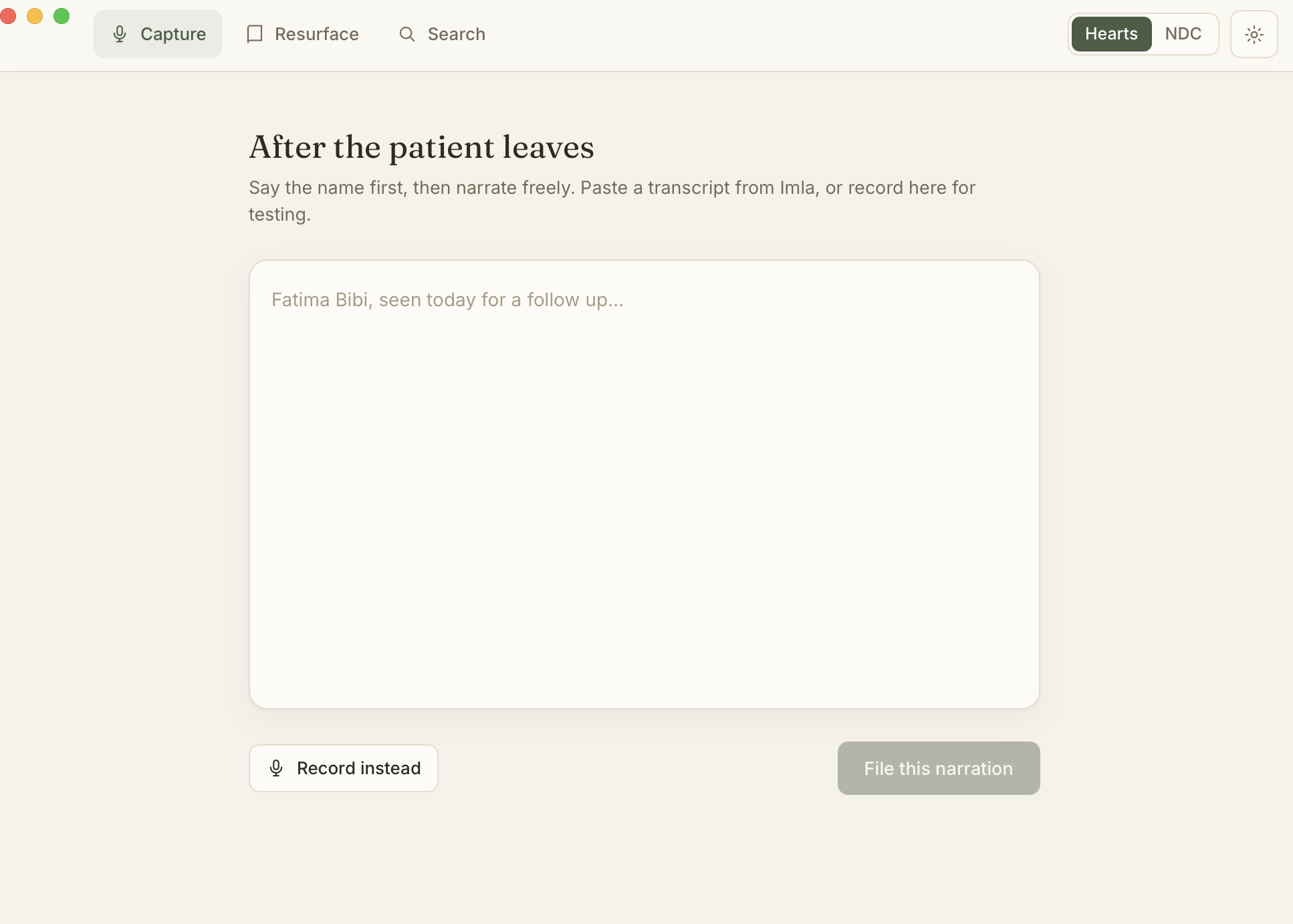
Bayaz is a private desktop app: press record, narrate a story about a patient (or an anonymous one, unattached to any record), and it transcribes on-device, tries to resolve which patient you mean, and then stops — waiting for an explicit confirmation before anything is saved. Once filed, narrations become searchable by meaning (not just keyword) and browsable by tag, and a "Resurface" view synthesizes everything ever narrated about one patient into a single read.
A state machine built around one rule: never file without a human decision
confirming and mergeConfirm stages are explicit stop points in the state machine — a narration is never auto-attached to a patient record without a human answering first.exact match, a needsConfirm set of candidates with a confidence and reason, or noMatch — with a merge-suggestion flow to prevent duplicate patient records across two hospital sites.Under the hood
| Shell | Tauri v2 (Rust) desktop app for macOS |
| Frontend | React 19 + Zustand + TypeScript |
| Transcription | On-device via Imla (whisper.cpp + Metal) |
| Search | Local embeddings for semantic search over narrations |
Where it stands
In active development — a working local desktop build, currently the tool I use myself day to day, ahead of any wider release.